← Writing
11August 10, 2026
The Rise of Single-Use Software
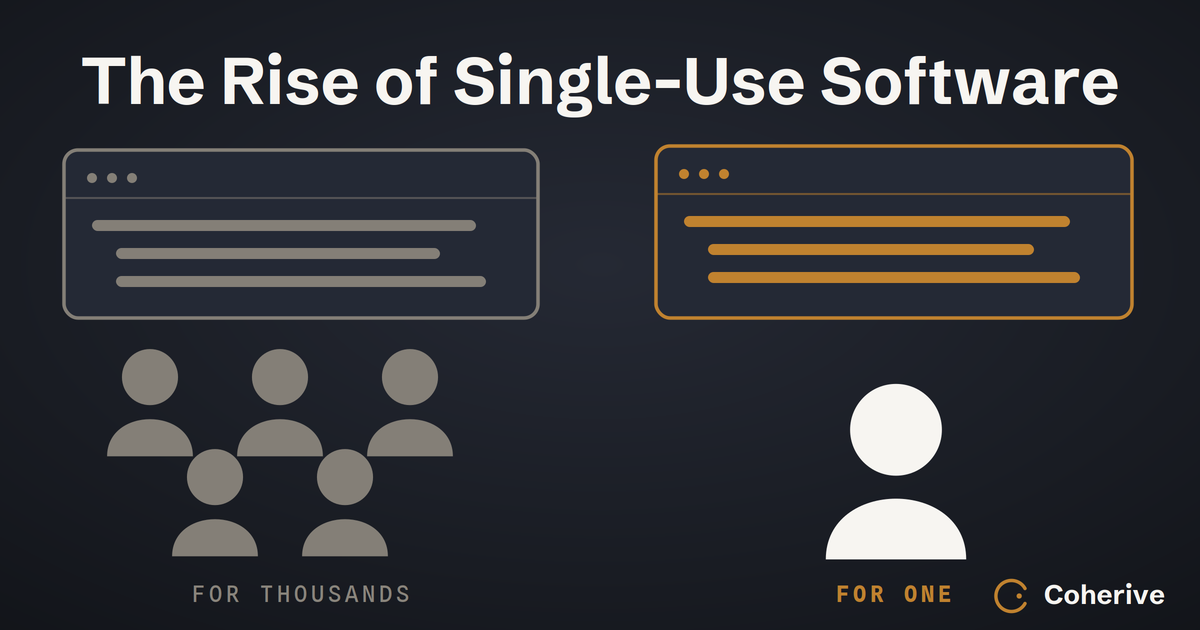
For decades, building software only paid off if a lot of people used it a lot. That rule quietly ruled out a whole category of useful tools: the one-off, the one-team, the thing you run once. Now it’s gone. And capturing what that opens up isn’t a mindset you announce. It’s a structure you build.
For a long time, building custom software only made sense if a lot of people were going to use it, a lot. It cost too much, and took too long, to build any other way. So the math was simple. Unless you had the volume to spread that cost and time over, it wasn’t worth building. That one rule, sitting quietly in the back of every leader’s head, killed off a whole category of problems. The one-off. The thing one team does. The report that runs once a quarter. All of it just got done by hand, forever, because it could never clear the bar.
That bar was made of cost and time, and both have fallen through the floor. How long a build takes depends on the problem, but the whole range has dropped. I’ve put together automations in under half an hour that wiped out a task someone was spending hours a day on. And here’s the shift. It doesn’t have to be reused to be worth it anymore. It pays for itself by solving the one thing in front of you. If it turns out to be handy again later, great, but reuse is a bonus now, not the price of admission.
Think about a carpenter who needs one tricky cut. He builds a little jig, a custom guide, to make that cut, and when the job is done he might toss it. He doesn’t write up a spec and hand it to a workshop across town. He builds it himself, because he’s the one who understands the cut. Single-use software works like that now. The person who owns the problem is the one who should build the tool, because the cost of explaining the problem to a separate team is now bigger than the build itself. That’s the part most companies are going to miss, because their whole structure assumes building software is something a different department does.
But here’s where it gets sharp, and this is the part you can’t wave off. The moment you tell people to go solve their own problems with AI, they will, with whatever tool happens to be open in their browser. And if nobody has told them what’s allowed, someone solves a real problem by feeding real data into a system you would never have approved. Customer records, financials, something covered by a rule you answer to, now sitting inside a public tool you don’t control. The tool did its job. The way it got built is the exposure. In a regulated business, that isn’t a hypothetical, it’s the first thing that goes wrong. The risk was never the building. It’s building with no guardrails around what goes where.
So the answer isn’t to lock it down, and it isn’t to turn everyone loose. It’s to give people a safe lane to build in, and that lane is mostly about data and systems, not red tape. Start with the data. What’s allowed into AI at all, what can only go into an approved, private environment, and what never goes in. Draw those lines before people build, not after. Then the systems. Which tools are sanctioned, and for anything confidential, are you giving them a private model you actually control instead of leaving them to improvise with a public one? If you don’t hand people a safe place to do this, they’ll do it in an unsafe one. Add the handling that matters, cleansing or stripping sensitive fields before data ever goes near a tool. And decide who builds, and train them. Not everyone, not nobody, the people who own the problems, taught to work inside the lane.
There’s a judgment running through all of this. Before you build, it helps to know whether this is a one-time fix or a problem that’s going to keep coming back, because that changes how you build it and where it should live. But you can’t always tell up front. A tool you built as a quick throwaway has a way of becoming something a whole team relies on every week. Once that happens, it’s not a personal tool anymore. It’s a business practice. And it can’t live on one person’s laptop, behind one person’s login, because when that person leaves, the tool leaves with them. So the structure needs a plan for that moment. You hand the tool over to the business. It gets hardened, put behind company logins, moved onto company systems, and given a real owner and a maintenance plan, so the business owns it and can keep it running long after the person who built it has moved on. Knowing when to make that handoff, and having a clean way to do it, is just as important as the guardrails you start with. I do this regularly, and it’s the step most people skip, right up until the person who built the thing is gone and nobody left knows how it works.
Get this right and it stops being a run of lucky one-offs. It becomes a muscle, your people solving their own problems in days, safely, and the ones that matter graduating into things the business owns. The shift itself is easy to see, and it isn’t going away. Building the tools is the easy part now. The hard part, the part that decides whether this helps you or burns you, is the structure around it. Who’s allowed to build. What data can go where. Which systems are safe. When a scrappy fix has to become something the company owns. That’s where the real questions show up, and it’s the part I spend my time on. The companies that win here won’t be the ones who spotted the shift. They’ll be the ones who built the structure to use it safely.