← Writing
10July 29, 2026
The Fix Is Simpler Than You’re Letting It Be
Ask a business leader over a beer what would actually help, and they’ll tell you in one sentence. Ask them in the boardroom and they reach for something big and slow. The gap between those two answers is where most of the waste lives.
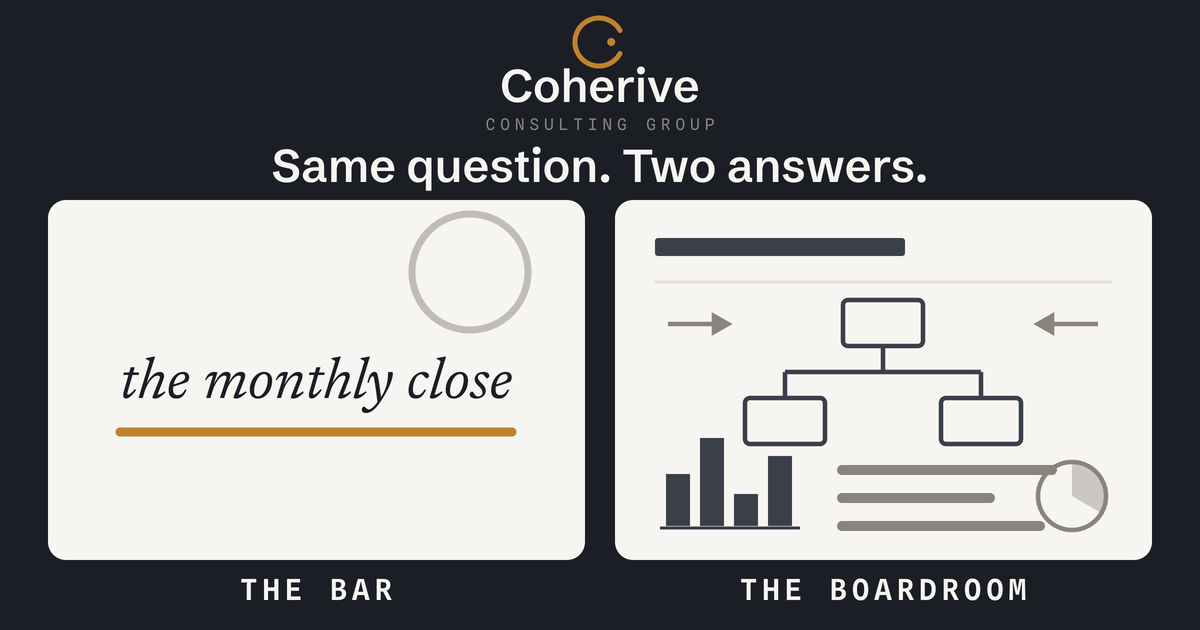
I’ve spent a lot of time on the other side of the table from business leaders, and there’s a pattern I see so often it’s almost funny. Get a leader talking over a beer, ask what would actually make their life easier, and you’ll get a straight answer in about one sentence. Honestly? If we could stop losing two days every month to closing the books, I’d be a happy man. Or, if quotes went out same-day instead of next-week, we’d win a lot more of them. Specific, true, no hesitation.
Now put that same person in a boardroom, guard up, and ask again. You get something else entirely. A company-wide data initiative. A platform. A strategy. The bar answer was real. The boardroom answer is a costume. And the sad part is, the costume is usually the one that gets funded.
Here’s what happens in between. The simple answer gets buried, and not because the leader is dim. Smart pressures push it under, all in the same direction. Simple doesn’t feel worth the money you’re about to spend, so it can’t be the real answer. Simple doesn’t sound impressive to a board that wants to hear bold. Big firms are paid to make things sound complicated, because complicated is what justifies the invoice. And underneath it all sits a quiet little fear: if the fix were really that easy, you’d have done it already, so it must not be.
Every one of those pushes a sharp person away from the answer they walked in with.
And look at what the bar answer usually is. It’s rarely anything exotic. It’s the report three people rebuild by hand every week that nobody actually reads. The two systems that never learned to talk, so someone reconciles them by eye every Friday. The approval that sits in an inbox for four days because nobody ever decided who owns it. Stuff you’ve stopped seeing precisely because it’s just how things are done around here. The value hides in the ordinary, which is exactly why the ordinary answer is the right one to chase.
And reaching past the obvious costs more than people admit. You spend six months and real money scoping the big program, and the whole time you’re scoping it, the two-day monthly bleed keeps bleeding. The obvious fix had a payback you could feel by the end of the month. The impressive one has a payback you’ll still be defending in a status meeting next spring. Reaching for big doesn’t lower your risk. It just delays the day anything actually gets better, and it spreads the win so thin you can’t even point at it.
Let me tell you what a lot of my work actually is, because it isn’t what people expect. It isn’t walking in and uncovering some genius insight the leader never had. Most of the time, the leader already knows. They said it at the bar. My job is to sit across from them, listen for that one sentence, and say: that. That’s the thing. Let’s go do that one, this month, and let it earn the right to the bigger conversation.
That sounds too simple to charge for, until you notice the obvious thing almost never gets done on its own. It needs someone from outside the building to look at it and say, plainly, that counts, that’s worth doing, go. Permission is a real deliverable. Leaders talk themselves out of the right move every day for the lack of it.
Now the honest part, because everything is simple is its own kind of snake oil. Not every problem is a two-week fix. Some things really are big, and the big ones deserve to be done with care. But here’s what stays true even then: the big ones almost always have a simple first move hiding inside them. A version you can start this month that proves the direction before you bet the year on it. The discipline was never always go small. It’s start with the obvious thing you already trust, and let it show you what’s next.
So if you’re a leader trying to figure out where to point your time and your money, the most useful question isn’t what’s our big AI play, or what’s the five-year plan. It’s much quieter than that. It’s this: what’s the thing I already know would help, that I’ve been talking myself out of because it seems too small to matter?
Start there. It’s almost always real. And it’s almost always been sitting there the whole time, waiting for someone to tell you it was allowed to be that simple.