← Writing
09July 15, 2026
Your AI Coding Assistant Won’t Tell You When You’re Off Track. Here’s How to Fix That.
You come to these tools expecting the AI chat experience, a partner that tests your thinking and tells you when you’re wrong. That’s not what a coding assistant is built to do, and expecting it to be is how projects quietly go sideways.
By now you know what it feels like to think with one of the AI chats. You float an idea and it engages. Sometimes it tells you your idea has a hole in it. It feels less like a tool than a sharp colleague who happens to be up at midnight.
So you start using one of the tools that let AI write your software, something like Claude Code or Codex, and you bring that expectation along. Same company, same name on the box, so surely it’s the same colleague, now with its hands on the work. Almost nobody will tell you it isn’t.
Here’s what you actually get. You say what you want, it makes it. It offers a next step, you approve it, and it charges ahead. It’s fast, and it feels like progress. What it never does is stop and say what a good colleague says: hold on, this whole direction is wrong, we’ve been going in circles for two days. It builds wherever you last pointed it, and never questions the plan.
And no, it’s not running a dumber engine. Underneath, it’s the same AI as the chat.
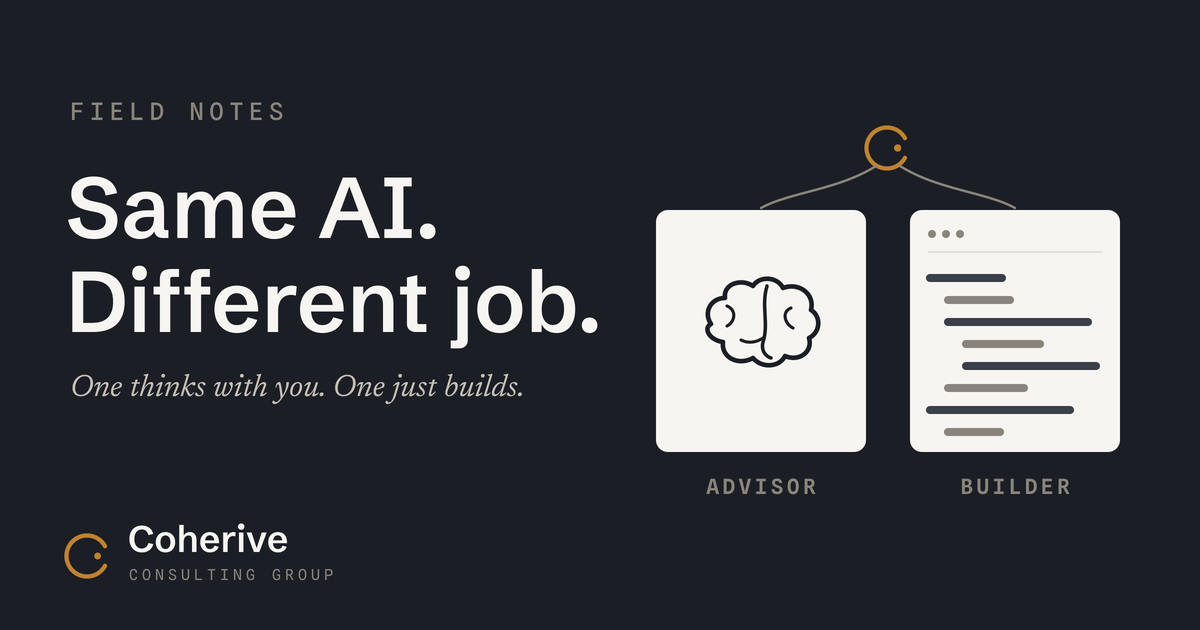
The difference is that the AI is only one ingredient. The product built around it decides what that intelligence is for. Think of it like hiring: the same sharp person is a very different employee depending on the job you give them. One is built to be your advisor: to think with you, weigh the options, and warn you before you hit a wall. The other is built to be your builder: to make what you asked for, fast. And a builder who stops every ten minutes to question the whole plan is a bad builder, so it was shaped not to. That’s not a defect. It’s a deliberate choice, and a good one. The trouble is nobody tells you which one you’re dealing with, and from outside they look the same.
The trap is that the failure is invisible. No error messages, just confident motion in a direction nobody questioned. Days pass, and the thing gets further along and further off. Because it feels like collaboration, you never think to look for the collaborator who isn’t there.
Here’s the move to watch for. One of these tools will hand you a summary of its own work, right next to the work itself. The summary always sounds a little better than the work deserves, and it’s usually what it wants to do next.
Picture a simple version. It grades its own work, tells you it’s strong here and weak there, and suggests you lean into the strength. But look at the grades it just gave itself. The category it called its strength, it failed most of them. It wasn’t good at that thing. It was just less bad at it than at everything else, and by the summary line, less bad had become good.
That’s the whole trap. The summary and the results don’t match, and the summary is the part you read. So you nod, you take the suggestion, and you’ve made a real decision off a flattering sentence instead of the evidence under it. It’s not lying. It’s doing what summarizing does. It rounds in its own favor.
You won’t catch that by staring harder, because the thing that wrote the flattering summary is the same thing you’d ask to check it. You need a second opinion from something that didn’t build it and has no reason to flatter it.
Here’s how to actually set that up, and it’s easier than it sounds. You don’t copy and paste code back and forth. You point a second AI, a plain chat this time, straight at the folder where your code is being written. Now it can read the real project, not a summary of it. A tool like Claude’s Cowork is built for this: give it access to the folder, and it can open the files and see exactly what the builder’s been doing.
From there it’s a genuine partner. You talk through the plan with it. You argue about the approach. You ask it, in plain words, what’s going on in there and whether it holds together, and it answers from the real code. It’s looking at the same work the builder made, but it didn’t make those choices and has no job to defend, so it’ll tell you the things the builder never will. I run one like this alongside every build now. It’s the difference between hoping the work is sound and seeing for yourself where it isn’t.
One honest limit. This catches muddled thinking, contradictions, and drift. It’s not proof the software works. It’s the second opinion, not the final inspection.
None of this takes a spare weekend or anything to install. It takes refusing to let the tool doing the work be the only voice in the room on whether the work is any good. Act on the work, not on the tool’s opinion of the work.