You’re the Executive. Make Your AI Coding Agent Report Back.
Direct an AI build for long enough and you lose your grip on how it actually works. The fix is to make it brief you, in plain language, the way a developer reports to the executive who signs off on what comes next.
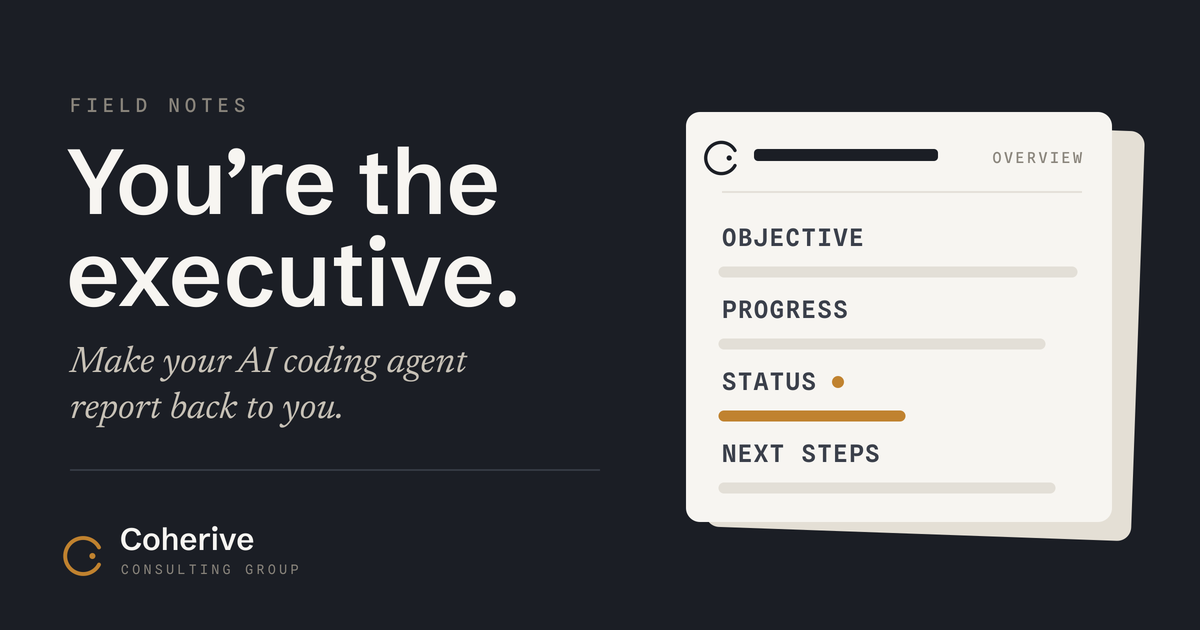
The brief you’re owed: objective, progress, status, next.
So you’ve spent the last couple weeks vibe coding your app, building it by talking to an AI agent, and honestly it’s going great. You set the goal. You make the calls. You prompt, it builds, you ship, and the thing’s further along than it had any right to be this fast. And then somewhere in there the details start to go foggy. You catch yourself on a question you can’t quite answer. How does that part actually work? Which of the three approaches it tried is still in there? Is the code really grounded the way you think it is, or have you just been nodding it through for a week? You’re still steering. What slipped is your grip on the machinery underneath.
Maybe you’re the one at the keyboard. Maybe it’s someone on your team, and you’re the one who has to answer for where it all lands. Either way it’s the same trap. Coding’s just where it shows up first, because that’s where the tools move fastest. It’s just as true of anything you hand off to a capable system and stop watching.
And this isn’t carelessness, and it isn’t some lapse in attention. It’s what happens when you hand the work to something faster than you. You give up the how so you can keep hold of the what, which is the right instinct, the only way to get anything out of a tool this fast. But the how piles up. Every little call about implementation sits on the last one, and a week of them stacks into a system you signed off on in pieces and couldn’t walk a stranger through. And you’re still on the hook for all of it.
You can keep your hands on the wheel long after you stop understanding the engine.
Think about how you’d handle this if the fast worker were an actual person. A good developer doesn’t disappear for a week and hand you a black box. They come back. They sit you down and explain, in words you can follow, what they built, why they built it that way, and what’s still open. You ask questions. You lean on the parts that don’t sit right. You okay the direction, or you change it. That conversation isn’t overhead. It’s how the person who owns the outcome keeps hold of it.
You’re owed that same conversation from the tool. You just have to ask, because it’s never going to call the meeting on its own. It’ll happily keep building wherever you last pointed it, and never stop to say hey, we might’ve lost the thread.
So make it stop and brief you. Ask it for an executive overview, in plain English, like you’re the person who has to sign off on this thing before it goes any further. Because you are. The exact wording I use is in the box below. Steal it.
I do this on every build now, and I wish I’d started sooner. The first time I ran it, it paid off in the first paragraph: two dead ends still sitting in the code, a spot where the build had wandered off from what I’d have picked, and a simpler way to the same place, buried under a week of trying. Fifteen minutes of getting briefed saved me days of building the wrong thing really well.
One honest catch, because it matters. The thing writing your overview is the same thing that did the work, so it’ll hand you a cleaner story than the code actually backs up. It’s not lying to you. It just carries the same blind spots on the way back that it had on the way in. So take the brief for what it is: the fastest way to get your hands back on the detail and catch drift, so you can make a real call. It’s not proof the work is solid. For that you look at the output yourself, or send a second, different agent in to check it. The overview keeps you in charge. It doesn’t do the checking for you.
And none of this means you have to go learn to code. You don’t have to read the code to be responsible for it, whether the hands on the keyboard are yours or your team’s. You just have to make the thing doing the work explain itself until you get it well enough to answer for it, then make the call. That’s not a coding skill. It’s the oldest part of running anything, and it works the same whether the worker is a person or a machine.
You didn’t stop being the executive when you started using AI. Most of us just quietly forget to act like it. Making it brief you is how you remember.
Who wrote this
I’m Eric. I run Coherive Consulting Group. I help companies in regulated industries put AI to work in weeks, using tools they already have, without the hype or the over-engineering.
Most of what I do starts with someone describing a problem they’ve been stuck on for months. If that’s you, eric@coherive.com.